
Chronic Illness Patient Research on Research:
Conversational Chats vs. Traditional Surveys
Previous research has shown that Reach3’s conversational approach is superior to traditional surveys among general consumers. But with the launch of our healthcare vertical, we wanted to confirm this with actual chronic illness patients and physicians.
What did we learn?
Reach3’s conversational chat surpassed traditional surveys on all key survey experience, data quality and data richness measures; making the conversational approach ideal for data and insight generation on sensitive topics, such as personal health issues.
1.
Conversational chats make research easier for patients to complete.
3.
Satisfaction with conversational chats exceeds that of traditional test-like surveys.
2.
Patients are more willing to share personal thoughts and feelings through a conversational chat.
4.
Conversational chats provide a qualitative richness that can’t be duplicated with traditional quantitative surveys.
1.
Conversational chats make research easier for patients to complete.
2.
Patients are more willing to share personal thoughts and feelings through a conversational chat.
3.
Satisfaction with conversational chats exceeds that of traditional test-like surveys.
4.
Conversational chats provide a qualitative richness that can’t be duplicated with traditional quantitative surveys.
Diving in Deeper
Diving in Deeper
1
Conversational chats make research easier for patients to complete.
Patients universally reported the conversational chat was easy to complete – signficantly more than the traditional survey format. This comes despite our respondents being third-party research-empaneled, frequent survey participants whom we can assume are familiar with standard survey functionality.
WHY IT MATTERS?
Ease of use is an important consideration where sample may be limited. It promotes increased satisfaction and engagement to help reduce abandonment and error. Over time, a better experience translates to increeased willingness to participate; facilitating larger sample sizes, and/or accelerating fieldwork speed. This is especially relevant in rare disease work and for new or low volume products.
Very or Somewhat Easy to Complete (T2B)
%
Conversational Chat
%
Traditional Survey
At the end of the survey, we asked respondents to share their feedback on the survey experience, including an option to submit a video selfie.
2
Patients are more willing to share personal thoughts and feelings through a conversational chat.
Looking at the open-ended survey feedback for context, respondents note that the conversational chat format provided an empathetic, familiar experience that allowed eczema patients to open up more fully than those completing a standard ‘test-like’ survey alternative.
WHY IT MATTERS?
Personal health topics are often sensitive and private matters. Helping patients express themselves candidly enables researchers to gain more accurate insights and a much richer understanding of what patients are going through.
Percentage of Patients More Willing to Express Personal Feelings
- Conversational Chat (T2B, TB) 70%
- 47%
- Traditional Survey (T2B, TB) 53%
- 25%
“I liked that this survey was considerate of how comfortable I may be answering certain questions.”
“I do admit I felt more open about sharing my thoughts and experiences…this survey was very enjoyable, even though I had to dive into some not so fun topics about my skin.”
3
Satisfaction with conversational chats exceeds that of traditional test-like surveys.
We asked about satisfaction two ways: Fun and Enjoyment (relative to other surveys). On both measures, Reach3’s conversational chat survey provided a more rewarding experience for patients.
WHY IT MATTERS?
Aside from the impact on future participation, increased satisfaction can help reduce abandonment and increase focus, which in turn can enhance data quality (e.g., minimize ‘straight-lining’).
More Fun
(vs other surveys)
- Conversational Chat (T2B, TB) 86%
- 56%
- Traditional Survey (T2B, TB) 67%
- 23%
Greater Enjoyment
(vs other surveys)
- Conversational Chat (T2B, TB) 85%
- 51%
- Traditional Survey (T2B, TB) 66%
- 28%
I really liked the format of this survey. The text kind of layout is much more fun and easier to use than other types of surveys I have taken.
The whole thing was easy and it was so fun. The format was terrific. Thank you.
4
Conversational chats provide a qualitative richness that can’t be duplicated with traditional surveys.
The chat platform allows for easy video submissions. We gave respondents the option of completing the chat open ends using a video selfie instead of typing in order to measure the differences in the depth or richness of responses as measured by the number of words spoken/typed for a given question. We have two comparisons ⬇️

Chat Selfie Videos vs. Traditional Typed Open Ends
Chat selfies yielded  more words than a Traditional typed response
We anticipated a deeper level of disclosure (e.g., more words) from chat selfie videos given its speed & ease of use in communicating of one’s thoughts cohesively; and this was confirmed with an even larger verbosity than seen within GenPop (7x).

Chat Typed Open Ends vs. Traditional Typed Open Ends
Chat Typed response yielded  more words than a standard typed response
However, we hadn’t anticipated the advantage that the chat format would have with typed responses as well. But in light of the enhanced engagement that conversational chats provide, its unsurprising.
WHY IT MATTERS?
Conversational chats – especially those leveraging the array of mobile phone features (photos, videos, screen record, screen capture, voice to text, etc.) unlock the ability to layer in true qualitative depth – and on a quantitative scale – which historically was only possible through time and cost intensive live interviews. Properly designed, chats also enable ethnographic, in-the-moment insights that are difficult to replicate via live, post-scheduled interviews.
I kind of enjoy the video surveys. I think it’s an easier way to express your opinions without having to type it all out sometimes. That can get tedious.
Average # of Words Per Open End Response
REASON FOR CHOOSING IMAGE
Chat selfie video 🎥
Chat typed response ⌨️
Traditional typed response ⌨️
MOST BOTHERSOME SYMPTOM AT DIAGNOSIS
Chat selfie video 🎥
Chat typed response 💬
Traditional typed response ⌨️
ISSUES/DRAWBACKS OF TREATMENT
Chat selfie video 🎥
Chat typed response 💬
Traditional typed response ⌨️
GENERAL SURVEY FEEDBACK
Chat selfie video 🎥
Chat typed response 💬
Traditional typed response ⌨️
The survey experience was great. I mean, it was very intuitive and easy to answer the questions, and, too, it’s actually one of the easiest on how to upload, to shoot the video or upload the video. It was very easy and very quick. Overall, the experience was very good.
* Its worth noting that not every open-ended question is an ideal candidate for a video selfie. In this case, we did not offer the selfie option for the most bothersome symptom, since it requires only a simple answer. This provided the opportunity to compare typed responses head to head as well.
Conclusion:
Reach3’s conversational chat-style surveys provide substantial benefits to patient researchers; offering distinct advantages over traditional ask-answer, test-style surveys for sensitive topics like personal health – particularly in instances where quality, candor and/or qualitative richness are valued.
Conclusion:
Reach3’s conversational chat-style surveys provide substantial benefits to patient researchers; offering distinct advantages over traditional ask-answer, test-style surveys for sensitive topics like personal health – particularly in instances where quality, candor and/or qualitative richness are valued.
Methodology
Minute Survey
Total Completes
The same survey questions were asked of eczema patients in a traditional ask-answer question format in a paginated survey and using a conversational style in Reach3’s chat-based linear survey

The chat program also allows for video responses to open-ended questions

Diagnosed eczema sufferer sample was sourced from an external research email panel and randomly assigned to one of two research arms

Outbound sample was balanced, and resultant data weighted using external eczema age distribution targets

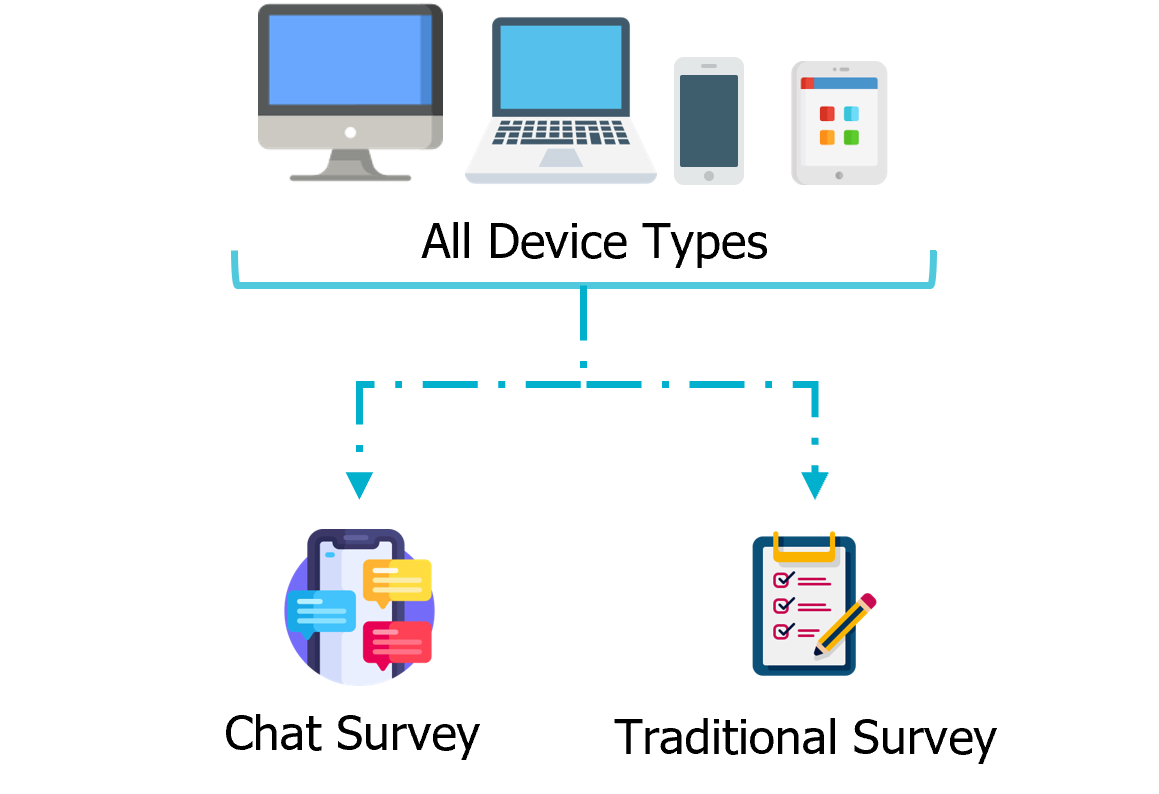
Device Independent Arm
Randomly assigned to traditional or chat survey, regardless of device for a real-world, apples-to-apples comparison. Data for each group was then weighted to a 50/50 ratio of mobile and computer users
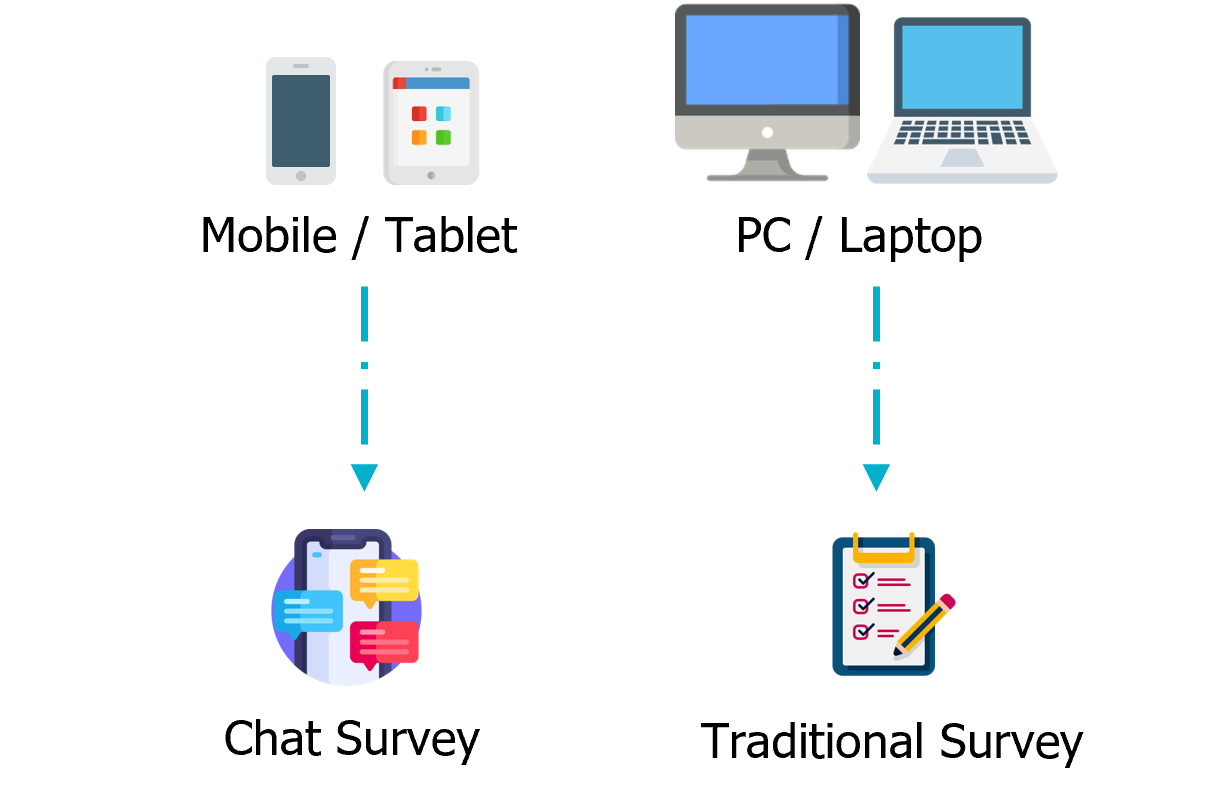
Device Dependent Arm
Mobile users were routed to chat and computer users routed to the traditional format on entry, providing a ‘control’ for any possible platform and format interactions
Results provided here reflect the real-world Device Independent data, but findings were generally consistent across arms.
Want to see our chat survey in action? Watch below! ⬇️
Want to Learn More? Questions?
Email dara.stlouis@reach3insights.com or
use the Contact button below.

www.reach3insights.com
info@reach3insights.com // SMS: (833) 4Reach3 // Phone: (833) 4Reach3