
Physician Research on Research:
Conversational Chats vs. Traditional Surveys
We’ve previously demonstrated that Reach3’s mobile-first conversational approach is superior to traditional surveys among general consumers, and now with the launch of our healthcare vertical, chronic disease patients as well. But we also wanted to see how well it works with busy professional audiences, such as physicians.
What did we learn?
Overall, Reach3’s conversational chat approach matched or surpassed traditional surveys on all key measures. Further, conversational chats completed on mobile surpassed other format-device combinations on all appliciable metrics. Conversely, the traditional ask-answer survey did not offer additional benefits on any measure; confirming that conversational chats offer distinct advantages over the typical, test-like surveys.
1.
Physicians find the conversational and traditional survey approach equally easy overall. However, a conversational survey completed via mobile is easier.
3.
Physicians perceive the conversational survey is faster than the corresponding traditional survey.
2.
Survey satisfaction is generally similar with both approaches, though completing a chat on mobile makes it even more fun & enjoyable.
4.
The conversational approach promotes enhanced richness and qualitative insight from physicians.
1.
Physicians find the conversational and traditional survey approach equally easy overall. However, a conversational survey completed via mobile is easiest.
2.
Survey satisfaction is generally similar with both approaches, though completing a chat on mobile makes it even more fun & enjoyable.
3.
Physicians perceive the conversational survey goes by more quickly than the corresponding traditional survey.
4.
The conversational approach promotes enhanced richness and qualitative insight from physicians.
Diving in Deeper
1
PHYSICIANS FIND THE CONVERSATIONAL AND TRADITIONAL SURVEY APPROACHES EQUALLY EASY OVERALL. HOWEVER, A CONVERSATIONAL SURVEY COMPLETED VIA MOBILE IS EASIER.
Physicians find both approaches generally easy to use. Yet conversational research completed on a mobile device was easiest, with physicians finding it easier than a traditional survey administered on the computer (and the other two combinations in the randomly assigned arm). This is despite our respondents being research-familiar physicians who report participating in 34 traditional surveys per year on average.
WHY IT MATTERS?
Ease of use is an important consideration in physician research. Their time is limited, and recruiting sufficient sample can be challenging. Since physicians are continuously solicited for research, enhancing their experience can help reduce survey abandonment while encouraging greater participation among targeted physicians.
Very or Somewhat Easy to Complete (T2B)
Randomly Assigned
Traditional OR
Conversational
%
Conversational
%
Traditional
Assigned by Device
Traditional on 💻
Conversational on 📱
%
Conversational
%
Traditional
2
Survey satisfaction is generally similar with both approaches, though completing a chat on mobile makes it even more fun & enjoyable.
To measure satisfaction, we asked about fun and enjoyment with the survey experience. Overall, results were comparable, but within the device dependent arm, we again see advantages for a conversational survey completed on a mobile device.
WHY IT MATTERS?
Let’s face it, physician survey topics can often be rather tedious and repetitive. Taking steps to reduce this monotony not only helps to promote greater attention and thoughtful responses, it can also help foster a greater willingness to participate over the longer term.
Randomly Assigned
Traditional OR
Conversational
Fun (T2B)
- Conversational 65%
- Traditional 61%
Enjoyable (T2B)
- Conversational 59%
- Traditional 65%
Assigned by Device
Traditional on 💻
Conversational on 📱
Fun (T2B)
- Conversational 81%
- Traditional 57%
Enjoyable (T2B)
- Conversational 81%
- Traditional 46%
“Loved the chat modality! Fun and simple.”
“Survey was fun…very interactive and concise, but still up to date.”
“Loved the pop-up questions, it felt more interactive and fun.”
HEAR IT STRAIGHT FROM PHYSICIANS! 🎥
3
PHYSICIANS PERCEIVE THE CONVERSATIONAL SURVEY IS FASTER THAN THE CORRESPONDING TRADITIONAL SURVEY.
They say time flies when you’re having fun! So as another way to assess engagement, we asked physicians how fast the survey seemed to go, relative to their estimated time-to-completion.
Overall, more physicians felt the conversational approach was faster. Consistent with other metrics, the differences were even more pronounced in the device dependent arm.
WHY IT MATTERS?
As physicain research topics can often times be rather dry, providing ways to increase respondent engagement while maintaining an organic experience helps maintain attention and focus to increase data quality, while bolstering completion rates.
% Felt It Went Faster Than Actual (T2B)
Randomly Assigned
Traditional OR
Conversational
- Conversational 41%
- Traditional 29%
Assigned by Device
Traditional on 💻
Conversational on 📱
- Conversational 51%
- Traditional 14%
Interesting and interactive, seemed to flow faster.
Definitely a very different way to do a survey, and not as tedious as many.
HEAR IT STRAIGHT FROM A PHYSICIAN! 🎥
4
THE CONVERSATIONAL APPROACH PROMOTES ENHANCED RICHNESS AND QUALITATIVE INSIGHT FROM PHYSICIANS.
The chat platform allows for easy video submissions. We gave our physician respondents the option of completing the chat open ends using a video selfie instead of typing in order to measure the differences in the depth and richness of responses as measured by the number of words spoken/typed for a given question. We have two comparisons ⬇️

Chat Selfie Videos vs. Traditional Typed Open Ends
Chat selfies yielded  more words than a Traditional typed response
While chat selfies work well with general consumers (7x more words), we weren’t sure if physicians would be similarly verbose. While physicians tend to be less verbose in general, the relative increase was greater.

Chat Typed Open Ends vs. Traditional Typed Open Ends
Chat typed response yielded  more words than a standard typed response
It also turned out that the chat format itself prompted deeper disclosure. Another benefit of an enhanced respondent experience and engagement.
WHY IT MATTERS?
In addition to efficiently gaining qualitative insights at scale; conversational chats leveraging the array of mobile phone features (photos, videos, screen record, screen capture, voice to text, etc.) enable true qualitative perspective from sought-after, high volume physicians who might not have availability to participate in traditional, scheduled qualitative interviews.
Average # of Words Per Open End Response
ISSUES/DRAWBACKS OF TREATMENT
Chat selfie video 🎥
Chat typed response 💬
Traditional typed response ⌨️
GENERAL SURVEY FEEDBACK
Chat selfie video 🎥
Chat typed response 💬
Traditional typed response ⌨️
HEAR IT STRAIGHT FROM A PHYSICIAN! 🎥
Conclusion:
Reach3’s conversational chat-style surveys provide substantial quantitative and qualitative benefits for physician research. It can help maximize participationn, increase data quality, and facilitate qualitative insights from otherwise difficult-to-recruit physicians.
Conclusion:
Reach3’s conversational chat-style surveys provide substantial quantitative and qualitative benefits for physician research. It can help maximize participationn, increase data quality, and facilitate qualitative insights from otherwise difficult-to-recruit physicians.
Methodology
Minute Survey
Total Completes

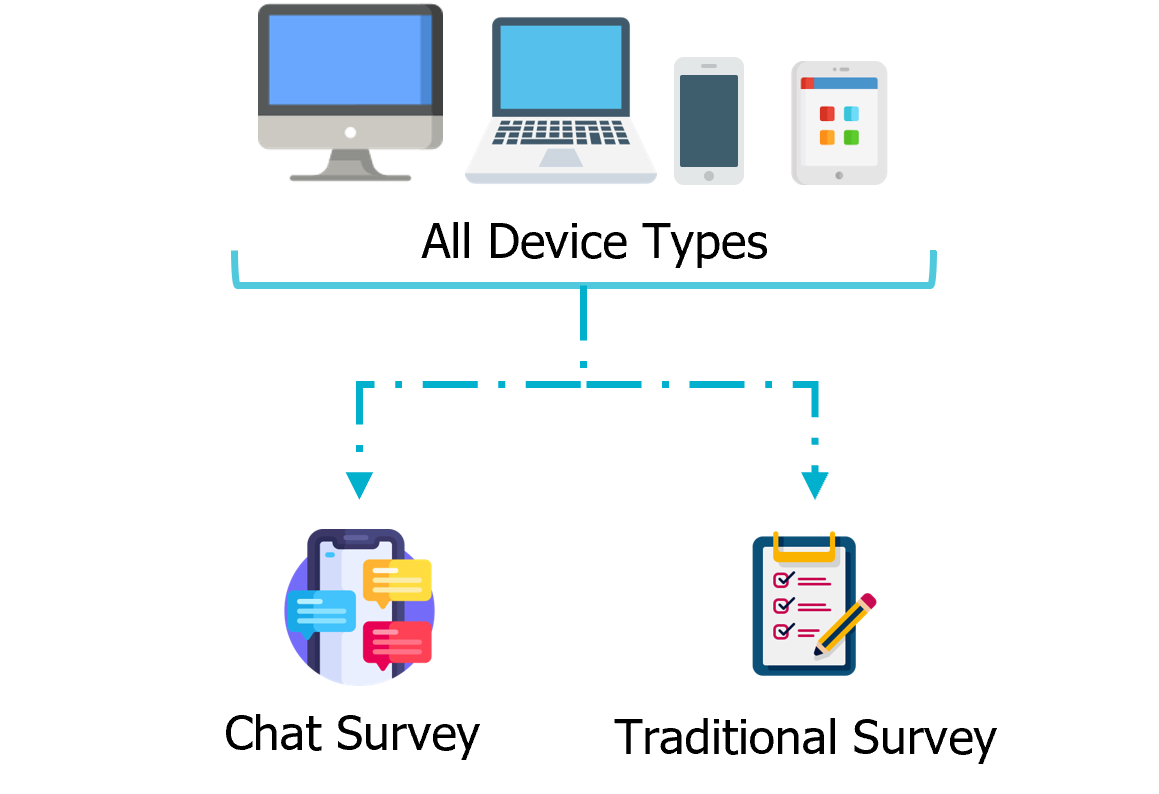
The same questions were asked of PCPs either in a traditional ask-answer format in a paginated survey, and a conversational format in Reach3’s chat-based linear survey, similar to texting.

The chat program also allows for video responses to open-ended questions

Sample was sourced from an external research email panel and randomly assigned to one of two research arms
Device Independent Arm
Randomly assigned to traditional or chat survey, regardless of device for a real-world, apples-to-apples comparison. Data for each group was then weighted to a 50/50 ratio of mobile and computer users
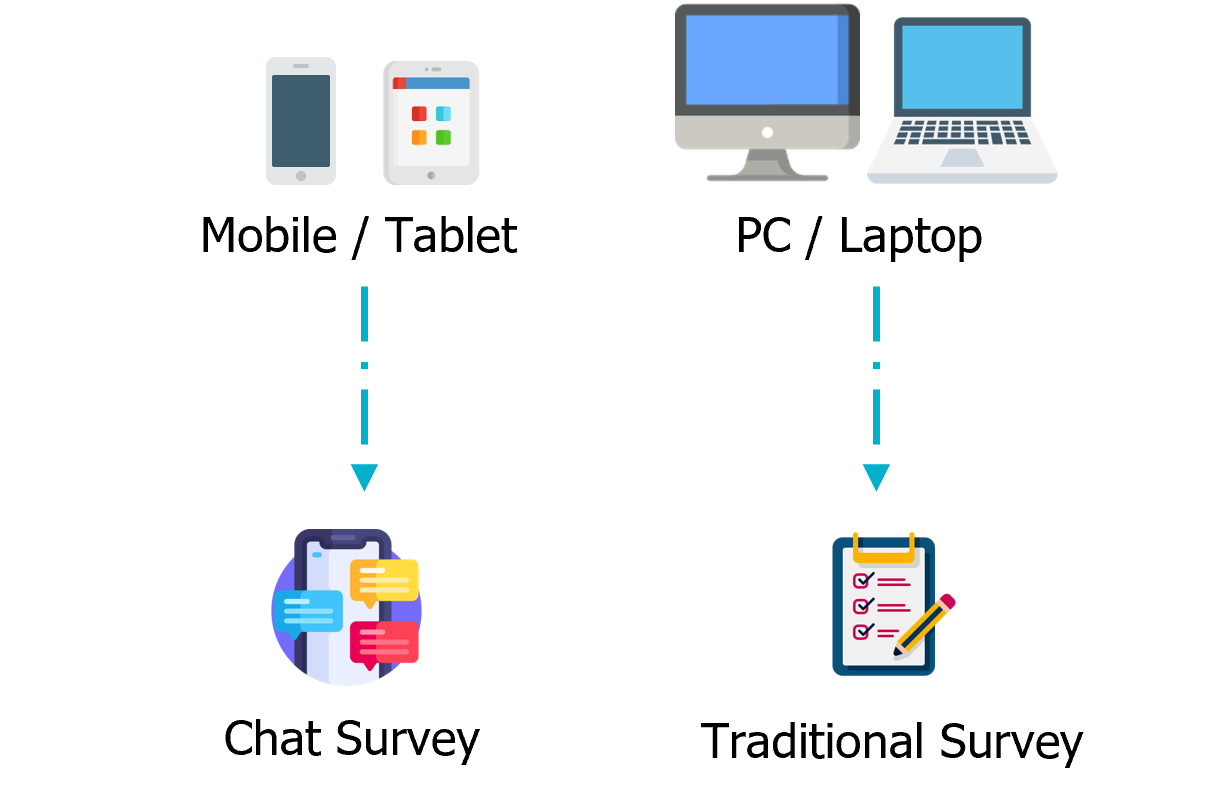
Device Dependent Arm
Mobile users were routed to chat and computer users routed to the traditional format on entry, providing a ‘control’ for any possible platform and format interactions
Results reflect the real-word Device Independent data unless otherwise noted.

Outbound sample was balanced, and resultant data weighted using external eczema age distribution targets
Screening criteria included:
- Primary care physicians (General, Family, or Internal Medicine)
- In practice between 3-35 years
- Spent at least 70% of time in patient care
- Treat at least 3 patients with eczema per month
- Standard industry exclusions
Curious to see our chat survey in action? Watch below! ⬇️
Want to Learn More? Questions?
Email dara.stlouis@reach3insights.com or
use the Contact button below.

www.reach3insights.com
info@reach3insights.com // SMS: (833) 4Reach3 // Phone: (833) 4Reach3